Cajun? How to trace your family back to Acadia, and where the records are
Published 12 November 2026.
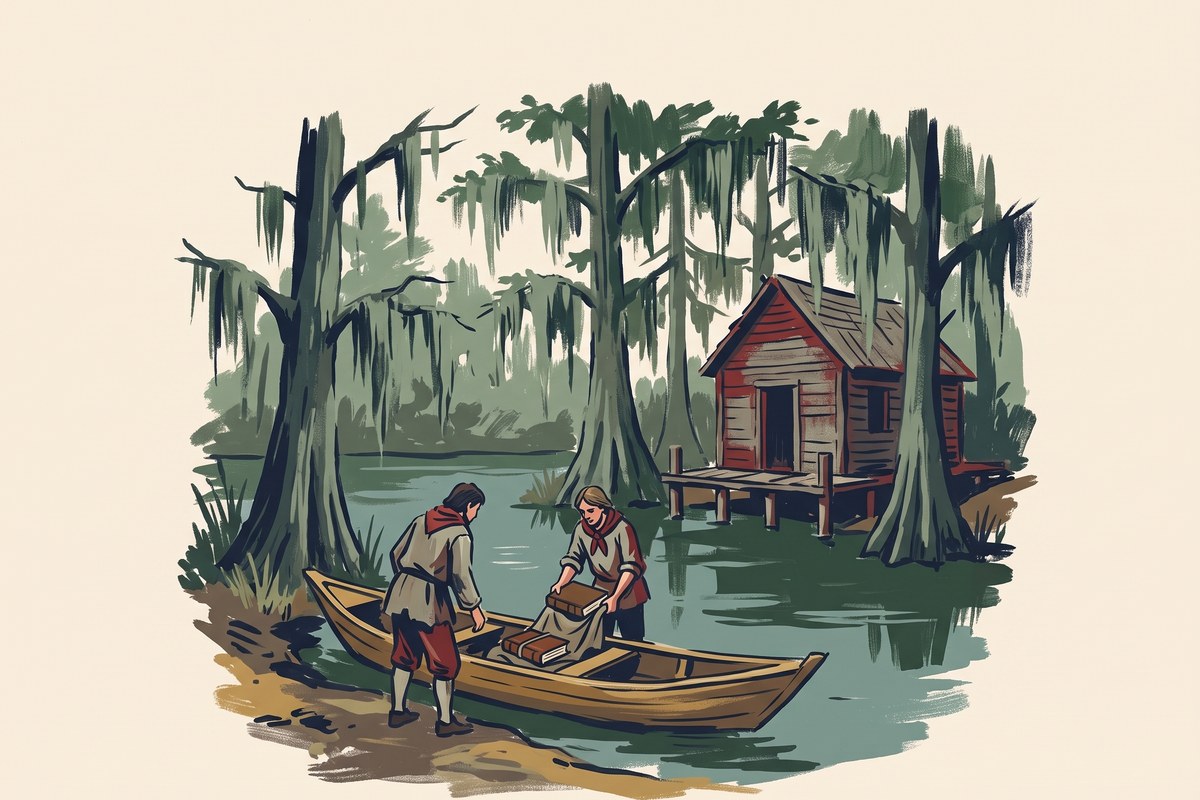
If your family is Cajun, your story most likely starts in Acadia. That's today's Nova Scotia, New Brunswick and Prince Edward Island.
About 3,000 Acadians reached Louisiana between 1765 and 1785. Names like Broussard, Hebert, LeBlanc, Landry, Dugas, Trahan, Babin and Thibodeaux all come down from them.
The records that connect a Louisiana family to Acadia are scattered across four countries. Some of them are in Louisiana itself.
Have an Acadian or Cajun ancestor? Request a Gen 0 Check, $49. We look for their baptism record and tell you where it's held.
How Acadians ended up in Louisiana
In 1755, British authorities began deporting the Acadians from Nova Scotia. Families were shipped to the British colonies, from Massachusetts down to Georgia, and many were later sent on to England and France.
Others were held for years in British prison camps at Halifax and Fort Edward, in Nova Scotia.
In February 1765, Joseph Broussard dit Beausoleil reached New Orleans with about 200 Acadians from the Halifax camps. France had handed Louisiana to Spain, but the first Spanish governor didn't arrive until 1766. The officials still in charge settled them along Bayou Teche, in the Attakapas district.
More families came from Maryland and Pennsylvania in the years after. In 1785, seven ships brought Acadians who had been living in France for close to 30 years.
They settled along the Mississippi above New Orleans (the "Acadian Coast"), on Bayou Lafourche, and around St. Martinville, Opelousas and Lafayette.
Which of your ancestors was born in Acadia
Because of the deportation, a Cajun line often has a generation born somewhere other than Acadia or Louisiana.
A child could be born in Maryland in 1761, or in Saint-Malo, France, in 1770.
Children born in the Halifax prison camp, from 1755 to 1764, were born in Nova Scotia. Their baptisms are hard to find.
So the person to look for is the last ancestor in your line who was born in Acadia. Their parents usually were too. Their children may have been born in exile.
We call the ancestor born in Canada your Gen 0. For many Cajun families, that's someone born at Port-Royal, Grand-Pré or Beaubassin before 1755.
Which Acadian registers survived
The British burned Acadian churches during the deportation, and many registers went with them. What's left is held in very different places:
| Parish | Today | Years that survive | Where the registers are |
|---|---|---|---|
| Saint-Jean-Baptiste, Port-Royal | Annapolis Royal, Nova Scotia | 1702 to 1755 | Online at the Nova Scotia Archives |
| Saint-Charles-des-Mines, Grand-Pré | Grand-Pré, Nova Scotia | 1707 to 1748 | Diocese of Baton Rouge archives, Louisiana |
| Beaubassin parish | near Amherst, Nova Scotia | 1679 to 1686 | Quebec |
| Same parish, later years | 1712 to 1748, with gaps | Archives départementales de la Charente-Maritime, La Rochelle, France | |
| Petitcoudiac mission | southeastern New Brunswick | 1753 to 1757 | Quebec |
The Grand-Pré registers surprise most people. Acadians carried them into exile, and they ended up in Louisiana. The Diocese of Baton Rouge has published them in its church records series.
So a Cajun family's Acadian baptism may be sitting in Baton Rouge, not in Nova Scotia.
What's missing:
- Port-Royal before 1702
- Pisiguit (today's Windsor, Nova Scotia)
- Cobequid (today's Truro area)
- most of Beaubassin between 1687 and 1711
If your ancestor was born in one of those places or years, there's likely no baptism to find.
A child born at Grand-Pré after 1748 is in the same spot, because the surviving register stops that year.
When the baptism didn't survive
Other records can still show who a person's parents were and where they were born. These are the ones Cajun researchers lean on.
1. The Louisiana marriage record
Catholic marriages in Louisiana often name both sets of parents and where the bride and groom were from. Some 18th-century entries are in Spanish.
2. The Spanish censuses of Louisiana
Spanish officials counted the Acadian settlements again and again: Cabanocé in 1766, the Attakapas post in 1769, Opelousas and Attakapas in 1777, and many more. They list households, with ages.
The originals are at the Archivo General de Indias in Seville, Spain, in the "Papeles Procedentes de Cuba" collection. You can search that collection through PARES, Spain's online archive portal.
3. Lists made during the exile
In 1763, lists were made of the Acadians living in Maryland and Pennsylvania. You can find them at Library and Archives Canada.
Passenger lists also survive for the seven ships of 1785.
4. Wills and successions
A Louisiana succession (the court file that settles an estate) sometimes names the dead person's parents. These are held by the clerk of court in the parish where the person died.
Records for the Louisiana generations
The generations born in Louisiana need their own records too, one for each person in the line.
Catholic baptisms. Most are still with the diocese that covers the church today:
- the Diocese of Baton Rouge (Ascension, St. James, Iberville and the river parishes)
- the Diocese of Lafayette (St. Martinville, Opelousas, Grand Coteau, Church Point)
- the Diocese of Houma-Thibodaux (Bayou Lafourche)
- the Archdiocese of New Orleans
Church archives are slow right now. In 2026, CBC News reported that the Diocese of Lafayette's turnaround had gone from two or three days to 12 to 16 weeks.
State birth certificates. The Louisiana State Archives holds birth records more than 100 years old. Before 1911, the only birth records it has are from Orleans Parish, so for older generations the church baptism is usually the record to look for.
Newer birth certificates are with the Louisiana Department of Health.
Spelling. Louisiana spellings drifted from the Acadian ones. Boudreaux was Boudrot, Breaux was Breau or Brault, and Thibodeaux was Thibodeau. Search both.
Many Cajun families have a Quebec line too
Not every French name in Louisiana is Acadian. Plenty of Cajun families also have an ancestor who came down from Montreal or another Quebec parish in the 1700s.
Quebec's parish registers are far more complete than Acadia's. If you have a Quebec line, it may be the easier one to document. Our post on Quebec baptism records explains where those are held.
If your family is Cajun
People with an ancestor born in Canada may already be Canadian citizens. The claim needs a birth or baptism record for every generation, back to that ancestor.
There's no special rule for Acadian descendants. The work is finding the records, and for Cajun families the trail runs through Louisiana, Nova Scotia, France and Spain.
Our post on why you need a record for every generation explains how the chain works.
Start with a Gen 0 Check, $49.
We look for your Acadian or Canadian-born ancestor's baptism record, then tell you which office holds it and how to order it. You receive the results within 3 business days.
Questions people ask
Are Cajuns and Acadians the same people?
Cajuns are the descendants of the Acadians who settled in Louisiana. The word "Cajun" comes from "Acadien."
Where are the Grand-Pré church records?
The surviving registers of Saint-Charles-des-Mines, 1707 to 1748, are at the Diocese of Baton Rouge archives in Louisiana.
Where are the Port-Royal church records?
The registers of Saint-Jean-Baptiste at Port-Royal, 1702 to 1755, are online at the Nova Scotia Archives.
My ancestor was born in Maryland or France. Now what?
That ancestor was born during the exile. Look one generation up, for the parent born in Acadia before 1755.
My ancestor's Louisiana record is in Spanish. Is that a problem?
No. Louisiana was a Spanish colony from the 1760s to 1803, and many church entries from those years are in Spanish. You'll want an English translation to read it.
What if my ancestor's baptism was lost?
Look for a marriage record, a Spanish census or a succession that names the parents and where the person was born.