Where French Canadians went in the U.S., and how to trace your family back to Quebec
Published 8 November 2026.
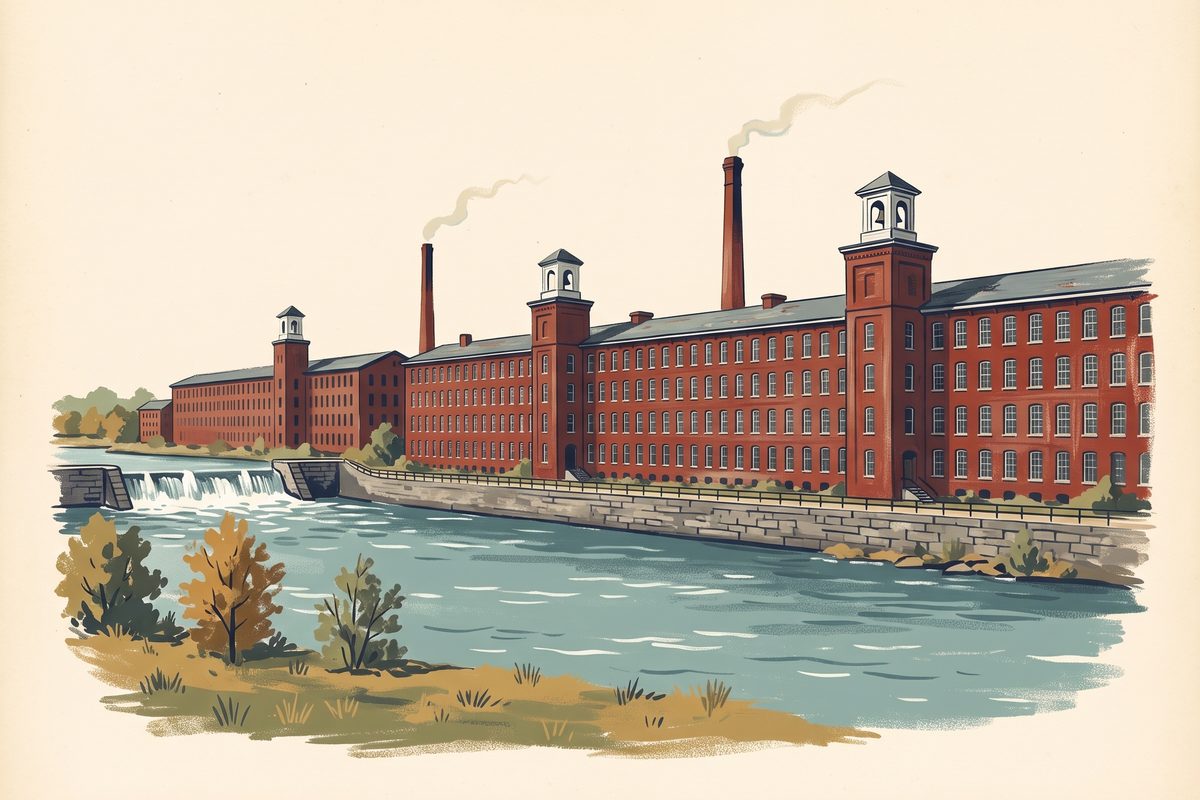
Between 1840 and 1930, about 900,000 French Canadians left Canada for the United States. Most of them went to New England, to work in the textile mills.
If your family has roots in Massachusetts, Rhode Island, New Hampshire, Maine or Vermont, there's a good chance one of your lines came down from Quebec.
Have a Quebec ancestor? Request a Gen 0 Check, $49. We look for their baptism record and tell you where it's held.
Why they left Quebec
Most of the people who left were from the poorer classes of rural Quebec, looking for work. That's how the Canadian Encyclopedia puts it.
As the population grew, family farms were divided again and again. Some historians call what followed an agricultural crisis.
New England needed workers. After the Civil War, the cotton mills couldn't get their old workforce back, and recruiters went to Quebec and brought down whole families.
Where they went
Most went to the mill towns of southern New England. A smaller group went west to Michigan, where Detroit drew many Canadian workers.
| City | What the numbers show |
|---|---|
| Woonsocket, Rhode Island | In 1913, 47% of the city spoke French, the highest share of any U.S. city in a study that year |
| Manchester, New Hampshire | In 1910, about a third of the city's 70,063 people were French Canadian |
| Lowell, Massachusetts | About 30,000 of the city's 100,000 people were Franco-American when Jack Kerouac was a boy in the 1920s |
| Fall River, Massachusetts | In 1900, 40% of the city's people claimed French Canadian ancestry |
| Holyoke, Massachusetts | French Canadians reached about 16,000 in 1910, in a city of 57,730 |
| Biddeford, Maine | In 1910, 8,697 of the city's 17,079 people were born in Canada or had a parent who was |
| Nashua, New Hampshire | In 1936, 14,560 of the city's 31,938 people were French |
Each figure comes from a local museum, park or historical society, listed under Sources. They count different things (people who spoke French, people born in Canada, people with French Canadian parents), so compare them with care.
Life in a Little Canada
Most of these towns had a French neighborhood, usually called Little Canada. It was built around a French parish.
Manchester's first French church, St. Augustine's, opened in 1871. Woonsocket's, Precious Blood, was organized in 1872.
The parishes ran French schools. Towns had French newspapers too: Woonsocket alone had fifteen of them, starting in 1873.
In 1908, French Canadians in Manchester started La Caisse Populaire Sainte-Marie, the first credit union in the U.S. It's still open as St. Mary's Bank.
Jack Kerouac grew up in Lowell's French community and spoke only French until he was about seven. His parents were both born in Quebec.
Lowell's Little Canada is gone now. The city cleared it for urban renewal in the 1960s.
Did your family live in one of these towns? A Gen 0 Check ($49) looks for the Quebec parish they came from, with results in 3 business days.
How to trace your family back to Quebec
A New England family's records usually lead back to Quebec in steps. Work from the most recent record back.
1. The U.S. census
The 1900 to 1930 censuses asked what year each immigrant came to the U.S.
Look at the birthplace column too. The 1900 instructions told census takers to ask anyone born in Canada whether they were of English or French descent, and the 1930 instructions said to write "Canada-French" for French speakers. So many entries read "Canada Fr." or "Canada-French," which tells you which side of the language line to search.
2. Border crossing lists
From 1895, the U.S. kept lists of people crossing in from Canada. They're held by the U.S. National Archives as the St. Albans District records, 1895 to 1954 (microfilm M1464, with indexes M1461 and M1463).
A crossing record often gives the town the person came from, and sometimes the relative they were going to.
3. U.S. naturalization
Not every French Canadian became a U.S. citizen, but many did. Papers filed in federal courts in New England are at the U.S. National Archives in Boston. Papers filed in county courts are usually at the state archives.
From late 1906, the forms asked for the town and date of birth, which is often the first record that names the Quebec parish.
4. The marriage in the French parish
French parishes in New England recorded marriages in the same style as Quebec, and the entry often names both sets of parents. The registers are held by each Catholic diocese (Manchester, Portland, Providence, Boston, Springfield, Fall River and the rest), so write to the diocese that covers the town.
With the parents' names, you can find the family in Quebec.
5. The baptism in Quebec
Quebec recorded births as baptisms in its parish registers. Each parish kept a second copy, and those copies are now at BAnQ, the Quebec provincial archives.
Our guide to Quebec baptism records covers how to order one and what it costs.
Don't want to work through all five steps yourself? Request a Gen 0 Check, $49, and we'll search for the baptism for you.
Local libraries and archives
Some of the mill towns have French Canadian research collections:
- American-French Genealogical Society, 78 Earle Street, Woonsocket, Rhode Island: more than 20,000 books
- Manchester Historic Association, Manchester, New Hampshire: the Amoskeag Manufacturing Company records
- Saint Anselm College, Manchester: the Franco-American collections, more than 600 boxes of records from the Association Canado-Américaine
- UMass Dartmouth: Fall River's Franco-American Civic League records and oral histories
If your family came from Quebec
If someone in your line was born in Quebec, you may be eligible for Canadian citizenship by descent.
The claim needs a birth or baptism record for every generation, back to the ancestor born in Canada. We call that ancestor your Gen 0. Our post on why you need a record for every generation explains how the chain works.
For many New England families, the Gen 0 is the person who crossed the border, and the record is a baptism in a Quebec parish.
Start with a Gen 0 Check, $49.
We look for your Canadian-born ancestor's birth or baptism record, then tell you which office holds it and how to order it. You receive the results within 3 business days.
Questions people ask
How many French Canadians moved to the U.S.?
About 900,000 left Canada for the U.S. between 1840 and 1930. That counts people who left, and some of them later went back to Canada.
Which states did French Canadians move to?
Mostly Massachusetts, Rhode Island, New Hampshire, Maine and Vermont. A smaller group went to Michigan, especially Detroit.
What does "Canada Fr." mean on a U.S. census?
It means the person was born in Canada and was French Canadian. The 1900 and 1930 census instructions both asked census takers to mark French or English Canadians separately.
Where are the parish records from New England's French churches?
Each Catholic diocese holds the registers for its parishes. Write to the diocese that covers the town where the marriage or baptism took place.
Where do I find my ancestor's baptism in Quebec?
The second copies of Quebec's parish registers are at BAnQ, the provincial archives. Our Quebec baptism records guide covers how to order one.
Canadian Roots Found does record research. We are not lawyers, and nothing here is legal or immigration advice. Town figures were checked against the sources below on 28 October and 8 November 2026.
Sources:
- Bélanger and Bélanger, French Canadian emigration to the United States, 1840-1930: https://www.many-roads.com/2010/02/06/french-canadian-emigration-to-the-united-states-1840-1930/
- The Canadian Encyclopedia, Franco-Americans: https://www.thecanadianencyclopedia.ca/en/article/franco-americans
- New England Historical Society, When New Englanders feared a French-Canadian immigrant conquest: https://newenglandhistoricalsociety.com/when-new-englanders-feared-a-french-canadian-immigrant-conquest/
- NEHGS Vita Brevis, Woonsocket, Rhode Island: the most French city in the United States: https://vitabrevis.americanancestors.org/2023/06/woonsocket-rhode-island-the-most-french-city-in-the-united-states
- Franco-American Centre of New Hampshire, Franco-American culture in New Hampshire: https://www.facnh.com/post/à-manchester-franco-american-culture-in-new-hampshire
- Smithsonian Folklife Festival 1999 program book (Manchester and Amoskeag): https://folklife-media.si.edu/docs/festival/program-book-articles/FESTBK1999_11.pdf
- New Hampshire Public Radio, La Survivance and Franco-Americans: https://www.nhpr.org/post/new-hampshires-immigration-story-la-survivance-and-franco-americans
- National Park Service, Jack Kerouac (Lowell National Historical Park): https://www.nps.gov/lowe/learn/historyculture/jackkerouac.htm
- National Park Service, Before the park (Lowell): https://www.nps.gov/lowe/learn/historyculture/before-the-park.htm
- Fall River Historical Society, Women at work: https://fallriverhistorical.org/WomenatWork/?p=3608
- Springfield Technical Community College, Our plural history: French Canadians: https://ourpluralhistory.stcc.edu/industrial/frenchcanadians.html
- Maine document on Biddeford's French Canadian population, 1910 (held by BAnQ): https://collections.banq.qc.ca/document/s/t/_QmFkKaWpNPcbz8q3CwzLQ
- Freedom's Way National Heritage Area, Nashua: https://freedomsway.org/?p=5007
- U.S. Census Bureau, 1900 and 1930 enumerator instructions: https://www.census.gov/programs-surveys/decennial-census/technical-documentation/questionnaires.html
- U.S. National Archives, Prologue: Canadian border crossing records: https://www.archives.gov/publications/prologue/2000/fall/us-canada-immigration-records-2.html
- American-French Genealogical Society: https://www.afgs.org/
- Saint Anselm College, Franco-American collections: https://www.anselm.edu/about/anselmian-hub/news/franco-american-collections-special-and-distinctive
- UMass Dartmouth Archives and Special Collections, Franco-American collections: https://archivesspace.lib.umassd.edu/repositories/3/resources/14